Showing posts with label water. Show all posts

Friday, 13 November 2015

Kili's glacial retreat: a preview

The world is beginning to wake up to some of the realities of climate change. Some of the most pristine landscapes on Earth, such as glacial peaks, are diminishing at alarming rates. We're starting to realise that the snowy, ice-covered caps existing today may not stick around to be enjoyed by our grandchildren. This threat isn't just in the high latitudes of our planet; the tropical mountain ranges of East Africa are a key location being affected by climate change.

The first video from the National Science Foundation is a great summary of some of the impacts caused by shrinking glaciers in Tanzania - the home to Mt. Kilimanjaro, part of the Eastern Rift Mountain range. Though melting/sublimating glacial ice due to climate change is a phenomenon occurring globally, increasingly significant consequences are expected in tropical mountain ranges, due to Africa's preferential warming predicted in the near future (1.5 times the global mean) (Niang et al 2014). The diminishing glaciers of Kilimanjaro have become a symbol of climate change in Africa (Thompson et al 2009). The second video is fascinating; a clip of conservationist Ian Redmond expressing his feelings towards climate change, after witnessing first-hand the vanishing glaciers on Mt. Kilimanjaro.

If you have a spare 10 minutes, make yourself comfortable and sit down with a cuppa, because I really recommend watching these.


To keep this introductory post short and sweet, I'll be drawing back to Mt. Kilimanjaro's shrinking glaciers and impacts on water at a later date. Coming up next: climate change in the Rwenzori Mountains and implications for water supply.

Monday, 19 October 2015

The Forecast: Droughts With a Chance of Flooding

Picture Africa in your mind's eye.

What do you see?

Deserts...lions, giraffes, elephants roaming across grasslands...sparse vegetation, perhaps?

A typical image conjured in one's mind of Africa? (Source)
Now visualise 4000 mile-long rivers, vast expanses of tropical rainforest, snowcapped mountains up to 20,000ft tall, numerous breathtaking waterfalls, and major tropical lakes. 

The alternative, perhaps overlooked perspectives of Africa (Sources: top left, top right, bottom)

As the second largest continent on the planet, situated between 37°N and 35°S and covering 20.4% of Earth's total land area (Sayre 1999), Africa encompasses a huge variety of terrestrial biomes from hot, dry desert to lush tropical rainforest. The 'desert and savannah' image of Africa is only a fraction of the reality.

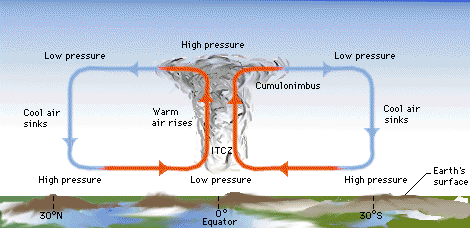
Africa straddles the equator, and its climate is largely determined by movement of the Intertropical Convergence Zone (ITCZ). This band is situated between two large atmospheric overturning circulations in either hemisphere: the Hadley Cells. These are driven by the differential heating of the planet. Where solar radiation concentrates at the equator, warm, moist air is forced to rise. As air rises and starts moving polewards, it cools and loses moisture, bringing seasonal rain to the tropics. The dry, cooler air then sinks, creating high pressure at the subtropics, which consequently forms 'Subtropical Dry Zones', where Earth's major deserts are found.

The Hadley Circulation and formation of the ITCZ between the two cells (Source)

This large low pressure rain band doesn't stay put for long, migrating south of the equator during the Northern Hemisphere (NH) winter, and shifting north of the equator during NH summer. African countries sitting between the ITCZ's annual path are blessed with rain throughout much of the year (e.g. Democratic Republic of Congo). However, countries which only greet the ITCZ once a year (e.g. Sudan) have just one deluge. Put simply, countries lying between the ITCZ's extent of movement are generally humid, and countries outside of that area are semi-arid or arid. The ITCZ is therefore vital in controlling the temporal and spatial distribution of precipitation across the continent.


Annual migration of the ITCZ (Source)

Global climate change is a very real and imminent threat to Africa's population, ecosystems and water resources (Carter and Parker 2009). Evidence is constantly growing to show anthropogenic warming has increased over the last century, particularly over parts of the arid African continent, where surface temperatures have risen by 0.5°C in the last 50-100 years (Niang et al 2014). The Intergovernmental Panel on Climate Change (IPCC) Fifth Assessment Report (AR5) suggests that towards the end of this century heat waves will increase, droughts will intensify, and extreme precipitation events will become more common (Niang et al 2014). Under a high emissions scenario (RCP 8.5) it is possible that Africa could warm by 3-6°C by the end of the 21st century (Niang et al 2014)! A temperature rise of that magnitude, though uncertain in probability, would seriously exacerbate existing water stresses.

The Clausius-Clapeyron relation demonstrates that as temperatures rise in a warmer world, the atmosphere can hold more moisture, hence the global hydrological cycle will intensify. Durack et al (2012) predict this intensification could be as much as 24% in a world warmed by 2-3°C. This would mean more extreme heavy downpour events, with fewer low-medium intensity events (Allan and Soden 2008). The general rule of thumb is the 'wet gets wetter, and the dry gets drier'. Dry North and Southern Africa are predicted to experience reduced rainfall, whilst relatively humid West and East Africa may experience more intense wet seasons (Niang et al 2014). For countries like South Africa, climate change could cause the loss of perennial (year round) water supply (de Wit and Stankiewicz 2006). Regional and local aspects of climate change in Africa mustn't be overlooked - hydroclimatic changes are not uniform across the continent!

There are MANY more consequences of climate change on various water resources in Africa that cannot be covered in this one introductory post. This is just the tip of the iceberg (excuse the pun). For now, it is important to recognise that climate change threatens to disrupt the rhythm African people have become accustomed to. Entire livelihoods can be based on one seasonal flood. If that flood doesn't happen in a warmer, uncertain future, crops will fail, livestock will starve, farmers will lose money, and Africa's taps might just run dry.

For more in depth information and a really good insight into climate change and policy in Africa, I recommend reading Chapter 22: Africa, in the IPCC's AR5 WG2 report - aka Niang et al (2014).

Tuesday, 13 October 2015

This is only the beginning...

Hello world, and welcome to my blog. Despite having experience with other forms of social media, this is the first (daunting, but exciting) time I have entered the blogosphere. So, what am I doing here? Over the course of the next 3 months I will be exploring the complex relationship between climate change and water in the continent of Africa.


Water is the essence of life. We humans can only survive 3 days without it. It is a fundamental element, not only for domestic use, but also for industry and agriculture. Climate change means that the things we have become accustomed to and take for granted, may be on the brink of drastic distortion, or even extinction! This is a pressing issue which requires immediate global attention to avoid putting millions of lives at risk. I care, and so should you.

Throughout this journey I will be investigating a broad range of topics including (but not limiting myself to) changes to existing weather patterns, impacts on water supply and quality, and impacts on agriculture, health and ecosystems. The distribution, supply, and access of water in Africa may notably change as we move into an uncertain, warmer future. As a physical geographer with a passion for all things climate-related, I will focus mostly on the physical science of the matter, but I will also address the social and political implications. Rather than adopting a strict agenda, I intend to go with the flow (pun intended) and follow my evolving interests as the blog and surrounding literature develops.


In my next post I will be delving into the depths of climate change, sorting fact from fiction, and specifically exploring the current water situation in Africa.

In the mean time, check out the short video below which sets the scene for some of the main features I'll be covering over the next few months.